
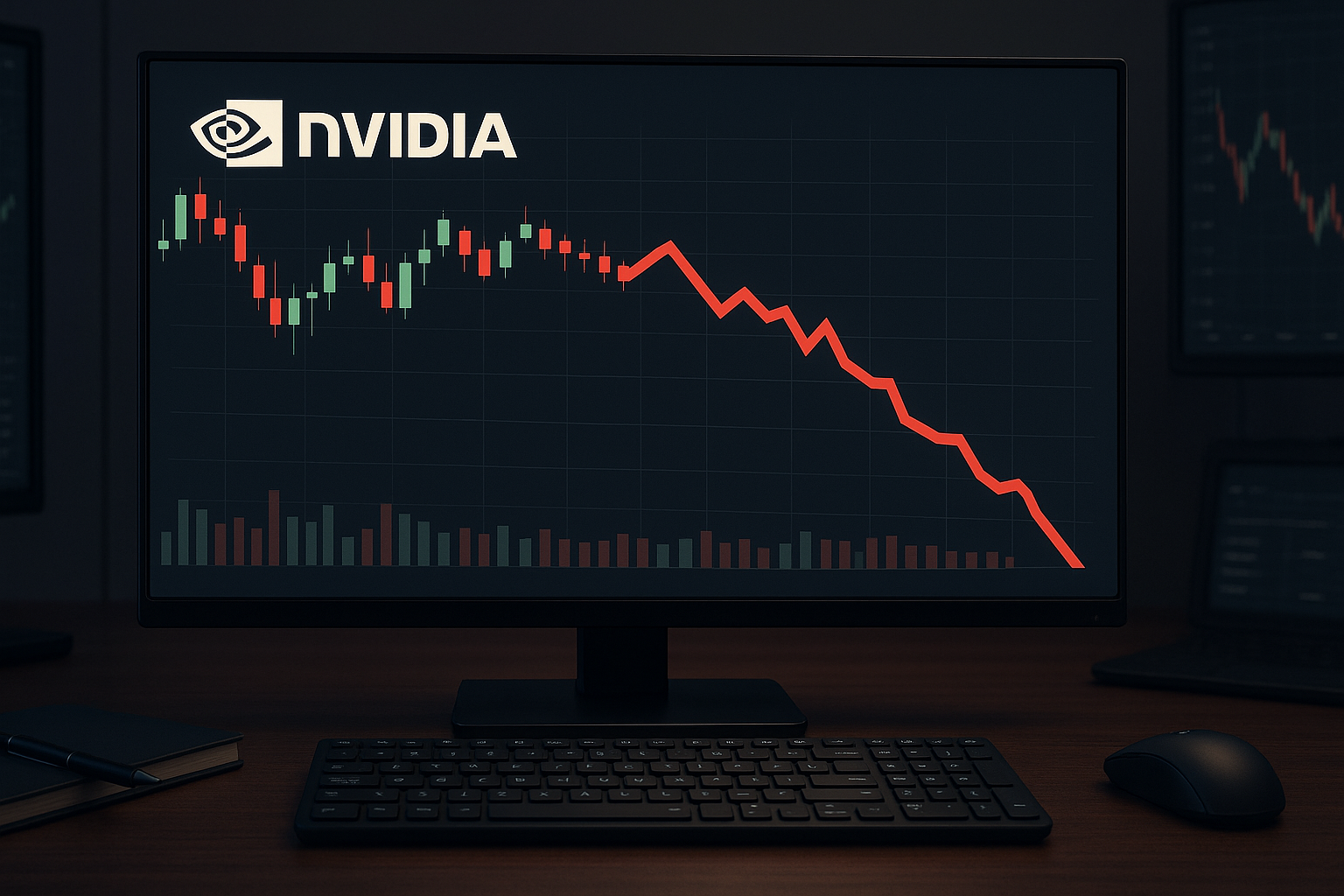
Nvidia's stock has taken a beating lately—down over 20% in just six weeks. And wouldn't you know it, here come the financial prophets, those same folks who couldn't buy enough shares at $130 but now solemnly declare it was "obviously overpriced" at $105.
Funny how crystal-clear hindsight works, isn't it?
Look, I've been covering tech stocks since before the pandemic, and if there's one constant, it's that valuation discussions around high-growth tech companies are essentially elaborate fiction writing contests. The line between "visionary premium" and "absolute madness" often has less to do with spreadsheets and more with which direction the ticker moved yesterday.
Not a Crash, Just a Breather
What we're witnessing probably isn't some dramatic revelation about Nvidia's true worth. It's what I call the "expectation digestion cycle" (and yes, I made that term up, but it fits). Markets surge, retreat, consolidate—they breathe. After Nvidia's nearly 600% climb since early 2023, a 20% pullback isn't just normal; it would be downright weird if it didn't happen.
The traditional view treats this as simple mean reversion. But something more nuanced is happening here: investors aren't questioning Nvidia's dominance—they're recalibrating their timeline of it.
I spoke with three fund managers last week who all shared a similar sentiment. They're not abandoning the Nvidia thesis; they're just stretching out the horizon a bit.
The Valuation Theater of the Absurd
Wall Street's valuation models remind me of those medieval astronomers who kept adding circles within circles to explain planetary motion. It's an elaborate system designed to force chaotic reality into tidy mathematical boxes. With Nvidia, traditional metrics like P/E ratios become almost laughably inadequate.
At its peak, Nvidia traded around 35-40x forward earnings—expensive compared to the broader market but actually reasonable for a company doubling earnings annually. The issue isn't the multiple; it's the assumptions baked into those "forward" numbers.
If you believe Nvidia will maintain its 80%+ market share in AI chips while the overall AI market grows 30% yearly for a decade, today's price looks like a steal. If you think Intel, AMD, and a swarm of startups will eventually crack Nvidia's moat... well, different story.
Both arguments can be made with equal conviction (and frequently are, in the same CNBC segment).
The Expectation Treadmill
Here's what fascinates me most: Nvidia might be suffering from an "expectation bubble" rather than a valuation bubble. The company has obliterated analyst estimates for six straight quarters, creating a psychological environment where investors began expecting not just growth, but growth that surprises even the optimists.
When companies consistently exceed expectations, Wall Street doesn't just price in excellence—it prices in perpetual amazement. This creates a dangerous dynamic where even stellar performance can disappoint if it merely matches already sky-high expectations.
Nvidia's recent earnings? Objectively spectacular. But the market had already penciled in spectacular-plus-a-cherry-on-top.
We've Been Here Before (Sort Of)
This isn't exactly uncharted territory. Amazon dropped over 90% when the dot-com bubble burst, despite eventually proving the bulls right. Microsoft lost half its value in 2000 and then went sideways for a decade despite growing substantially.
The difference is that Nvidia actually has the profits to justify its valuation, unlike many previous high-flyers. Those 45%+ net margins aren't theoretical—they're showing up in the bank account.
But—and this is crucial—even legitimate technological revolutions have their valuation adjustment periods. Railroad stocks, automobile manufacturers, early computer companies... all went through boom-bust-recover cycles despite being on the right side of history.
Having covered semiconductors for nearly a decade, I've watched this pattern repeat itself with different players. The fundamentals don't change overnight, but sentiment sure can.
The Market's Goldfish Memory
Markets suffer from severe recency bias. The narrative flips too easily from "this company is reinventing computing as we know it" to "it was obviously overvalued" based on a few weeks of price action. Neither extreme reflects reality.
A 20% drop after a 600% run-up isn't a repudiation of anything; it's the market taking a breath. Nvidia still powers virtually every major AI system out there. Its CUDA software ecosystem remains an enormous competitive advantage. And those profit margins? Still ridiculous.
The real question isn't whether Nvidia deserves a premium—it does. The question is how much premium makes sense given competitive threats and the actual pace of AI adoption.
In finance, as in physics, unbridled acceleration eventually meets resistance. Sometimes the most bullish long-term scenario requires a short-term reset to remain sustainable.
Even in the world of hypergrowth tech, gravity remains undefeated.


